Start with the food you actually store
A cupboard full of containers can still leave you searching for the right one. Before buying a set, notice what you put away during an ordinary week: a portion of dinner, cut vegetables, soup, a sandwich or a little leftover sauce. Also notice what tends to go unused. A large container may be convenient for a batch of food but awkward for a small serving; a tiny one may be perfect for dressing but too small for most leftovers.
For a week or two, use the containers you already have and make a short mental note whenever one is too big, too small or the wrong shape. This is more useful than guessing from a product photo. Check your refrigerator shelves, lunch bag and cupboard as well. A container only earns its space if you can fill it, carry it when needed, and find a place to put it away.
Build around a few repeatable sizes
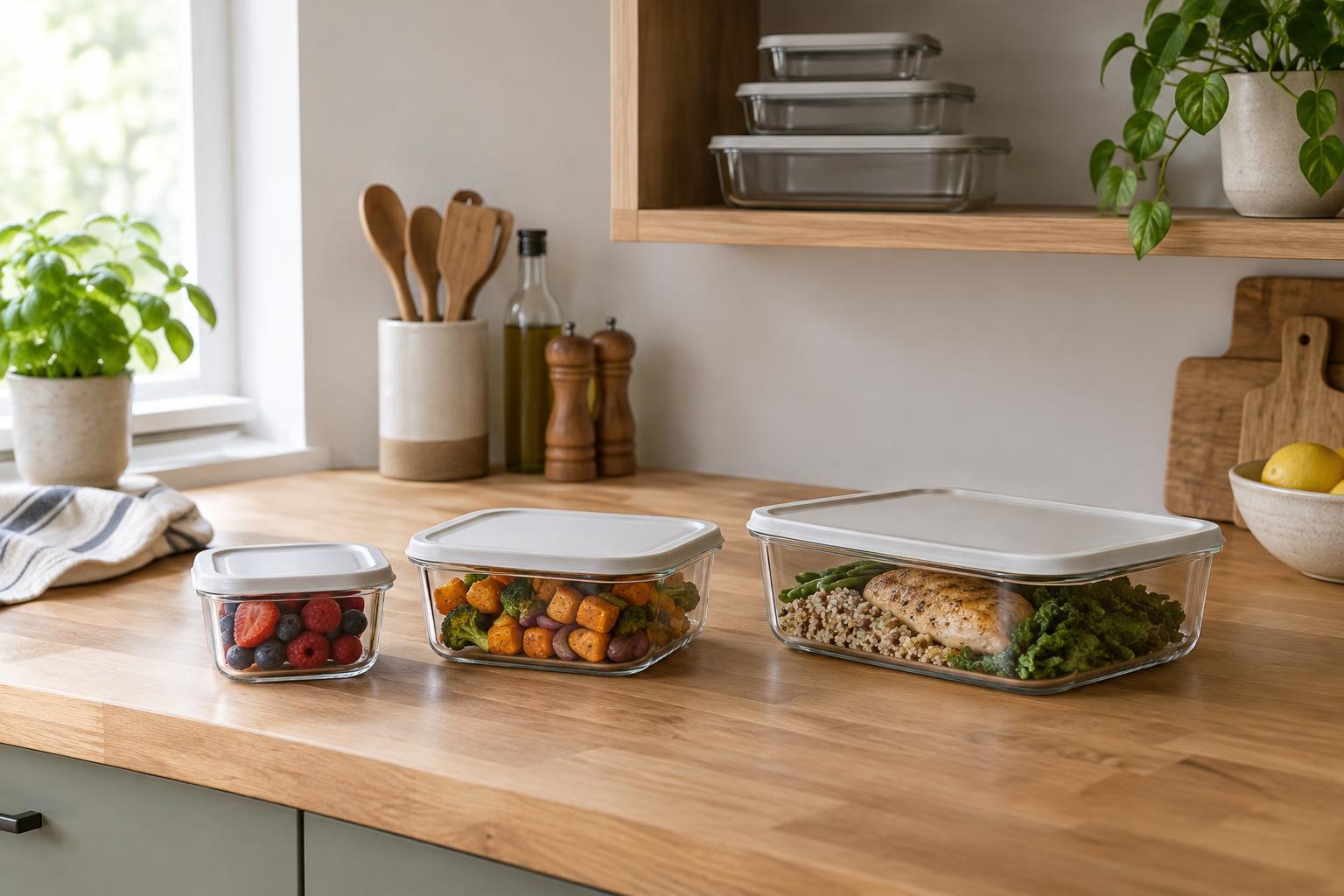
Most households can start with three roles rather than a large assortment: small containers for snacks, toppings or a few spoonfuls of leftovers; medium containers for individual meals; and larger containers for shared portions or batch cooking. Your version of “medium” depends on what you eat. Try putting a typical lunch or leftover serving in a container you own, then use that filled container as a reference when choosing another.
Shape matters as much as volume. A wide, shallow container can make it easier to see leftovers and spread out foods that you want to reheat evenly. A taller one may make better use of a narrow fridge shelf. Square or rectangular containers often sit neatly beside one another, but only if their lids and dimensions suit your space. Choose for the job you repeat most often, not for an idealized meal-prep routine.
Count lids, not just bases
Before adding anything new, match every base with a lid. Containers without usable lids may still help organize dry items, but they are less useful for transporting food. If you frequently lose track of lids, a small group of containers that share the same lid size can be easier to manage than many slightly different designs. Nesting bases and stackable lids can also make a modest set feel less cluttered.
Consider how each container will be used. For lunches or freezer storage, a secure closure matters more than it might for a bowl of leftovers that stays on one fridge shelf. Check the maker’s guidance for freezer, dishwasher and microwave use rather than assuming every reusable container can handle all three. Glass, plastic and metal each have practical trade-offs in weight, breakability and suitable uses. The best material is one you can use and care for consistently.
Try smaller changes before buying a set
A missing size does not always call for a complete replacement. Clean jars can hold some cold foods, and existing bowls with suitable covers may handle short-term refrigerator storage. Reusing a food package can also be practical when it is clean and appropriate for the job. Avoid treating a reused package as suitable for heating or freezing unless you know it is intended for that use.
If a gap remains, buy one or two containers in the size you reach for most. Secondhand finds can be useful if the pieces are clean, intact and have well-fitting lids. Check seals and closures in person when possible. Trying a small addition first lets you learn whether it fits your shelves and routine before committing cupboard space to a whole set.
Make the useful sizes easy to reach
Even a well-chosen container will not prevent waste if leftovers disappear behind newer food. Give prepared food a visible spot, let hot food cool appropriately before storing it, and follow ordinary food-safety guidance for refrigeration. If labels help your household identify what needs eating first, keep a pen and removable tape nearby. An easy routine matters more than a perfectly matched collection.
Review your containers when you notice a recurring problem, not whenever a new design catches your eye. If small ones are always in use while large ones sit empty, that tells you something about your real needs. Keep the pieces that regularly help you save and use food, and let the rest serve another purpose or move on where appropriate. A smaller set of right-sized containers is easier to maintain—and more likely to be used.