Start with where the water appears
A drip from the spout after the handle is fully closed often points to a worn part inside the faucet. Water around the handle may come from a seal or cartridge. Moisture beneath the sink could come from a supply connection, a hose, the drain, or water running down from above. Before buying parts, dry the area and watch where fresh water first appears. Check it with the faucet both off and running; those two conditions can reveal different leaks.
A few drops left in the spout immediately after use may simply be water draining out. A continuing drip is different. If water is reaching the cabinet floor, put a container or towel in place while you investigate, and do not leave an active leak unattended. Finding the source first can save you from replacing a working faucet part while the real problem continues.
When a washer is the likely fix
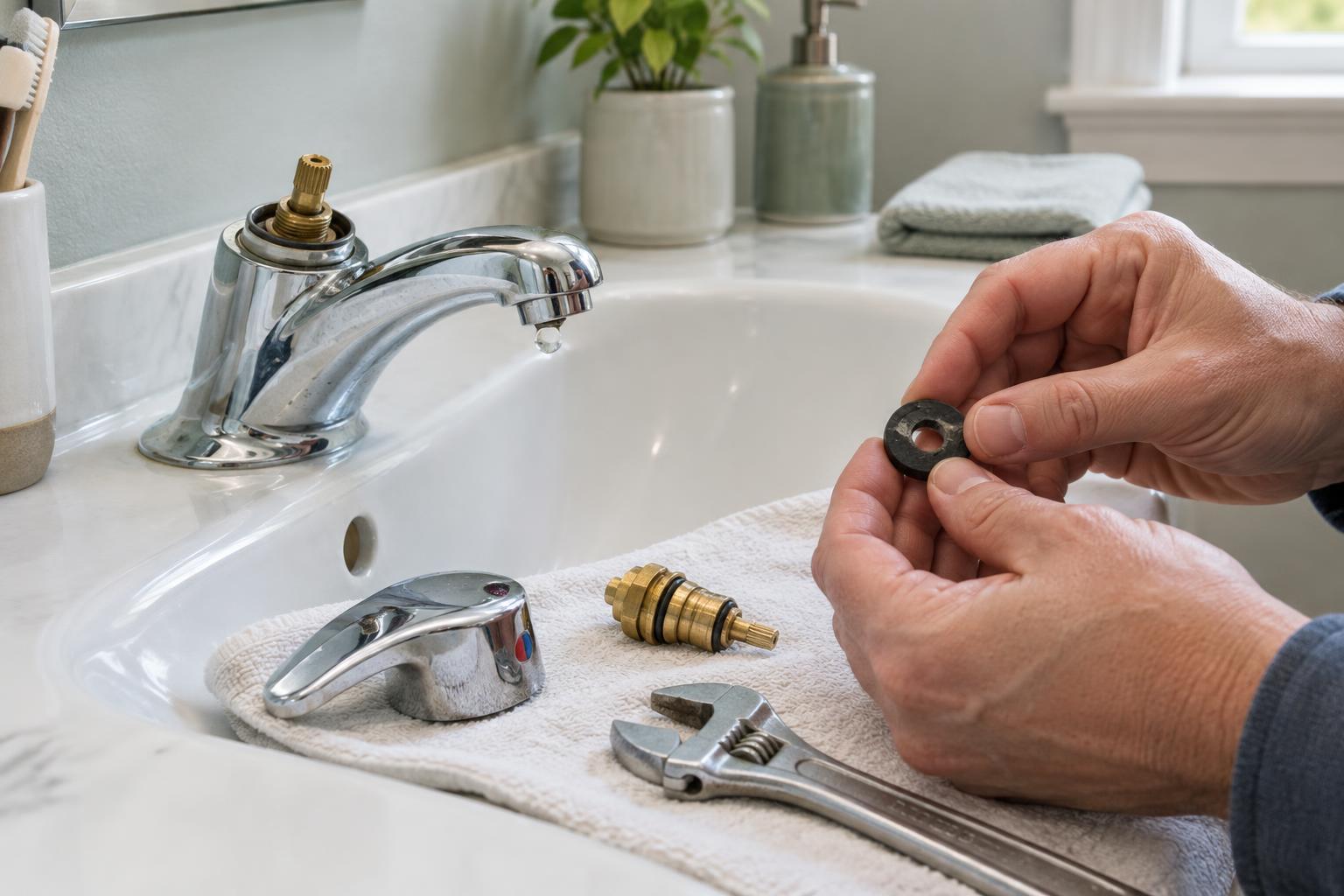
A traditional compression faucet usually has separate hot and cold handles that you turn several times to open or close. Each handle moves a stem that presses a rubber washer against a seat inside the faucet. When the washer wears or hardens, water may keep dripping from the spout even when that handle is closed. If you can tell which side is leaking, a replacement washer may be a modest repair that keeps the existing fixture in use.
The washer is not the only possible cause. A damaged seat can wear out a new washer quickly, and a leak around the handle may involve a different seal. If you take the faucet apart, bring the old part or the faucet’s model information when looking for a replacement. Parts that look nearly identical may not fit. Avoid tightening a handle harder and harder to stop a drip; that can add wear without solving the cause.
When to look for a cartridge
Many single-handle faucets, as well as some two-handle models, control water with a cartridge. A handle that lifts, swivels, or turns through a short range is a clue, though the faucet’s design is a better guide than handle movement alone. A worn cartridge can cause a spout drip, difficulty controlling temperature or flow, or leakage near the handle. Some faucets use ceramic-disc assemblies or ball mechanisms instead, so do not assume every single-handle faucet takes the same part.
Check for a brand name or model number on the faucet or in any paperwork you kept. Replacement cartridges are often specific to a model, and the seals supplied with them may matter as much as the main component. If you cannot identify the mechanism, take clear photos before removing anything and keep the parts in order. Guessing at a cartridge—or forcing one that resists removal—can turn a small repair into damage to the fixture.
Make a small repair without creating a bigger leak
Before loosening faucet parts, turn off the hot and cold shutoff valves under the sink, then open the faucet to check that the water has stopped and to release remaining pressure. If the valves do not close fully, stop there rather than taking the faucet apart. Plug the drain so small screws cannot fall in, protect the sink surface, and photograph each stage of disassembly. Use tools that fit; excess force can scratch finishes or damage threads.
After fitting the correct part, reassemble the faucet and turn the water back on slowly. Check the spout, handle, supply connections, and cabinet below while the faucet is off and while it runs. Check again later for dampness. A successful repair should stop the leak without making the handle unusually stiff or creating a new seep. If that does not happen, further tightening is not necessarily the answer.
Know when to call a plumber
Get help if you cannot shut off the water, a valve or fitting is badly corroded, water appears to be coming from inside a wall, or a leak is soaking cabinetry or flooring. A plumber is also a sensible choice when a cartridge is stuck, a faucet body appears cracked, or a correct replacement part does not stop the drip. These situations may involve more than the visible faucet component, and continued disassembly can make the problem harder to contain.
Repair and reuse are worthwhile goals, but they do not require saving every fixture. If the faucet body is sound and parts are available, replacing a worn washer or cartridge can extend its life. If the body itself leaks or parts cannot be found, replacement may be the more practical option. The useful habit is to diagnose the leak before discarding the faucet—and to stop when the repair exceeds what you can do safely.