Prevent the extras you can
The easiest takeout item to manage is one that never enters your home. Before placing an order, check whether you can decline disposable cutlery, napkins, straws or condiment packets. If there is an order note, a short request such as “No utensils or extra condiments, please” is usually enough. The restaurant may not be able to accommodate every request, but asking takes less effort than finding a home for another handful of forks.
Choose only the sauces you expect to use, and consider whether you need a drink if you already have one at home. When ordering for a group, ask what people actually want rather than adding every available extra. These small choices will not remove all packaging, especially when food needs to travel without spilling, but they can reduce the loose items that tend to collect in drawers.
Give packaging a place to land
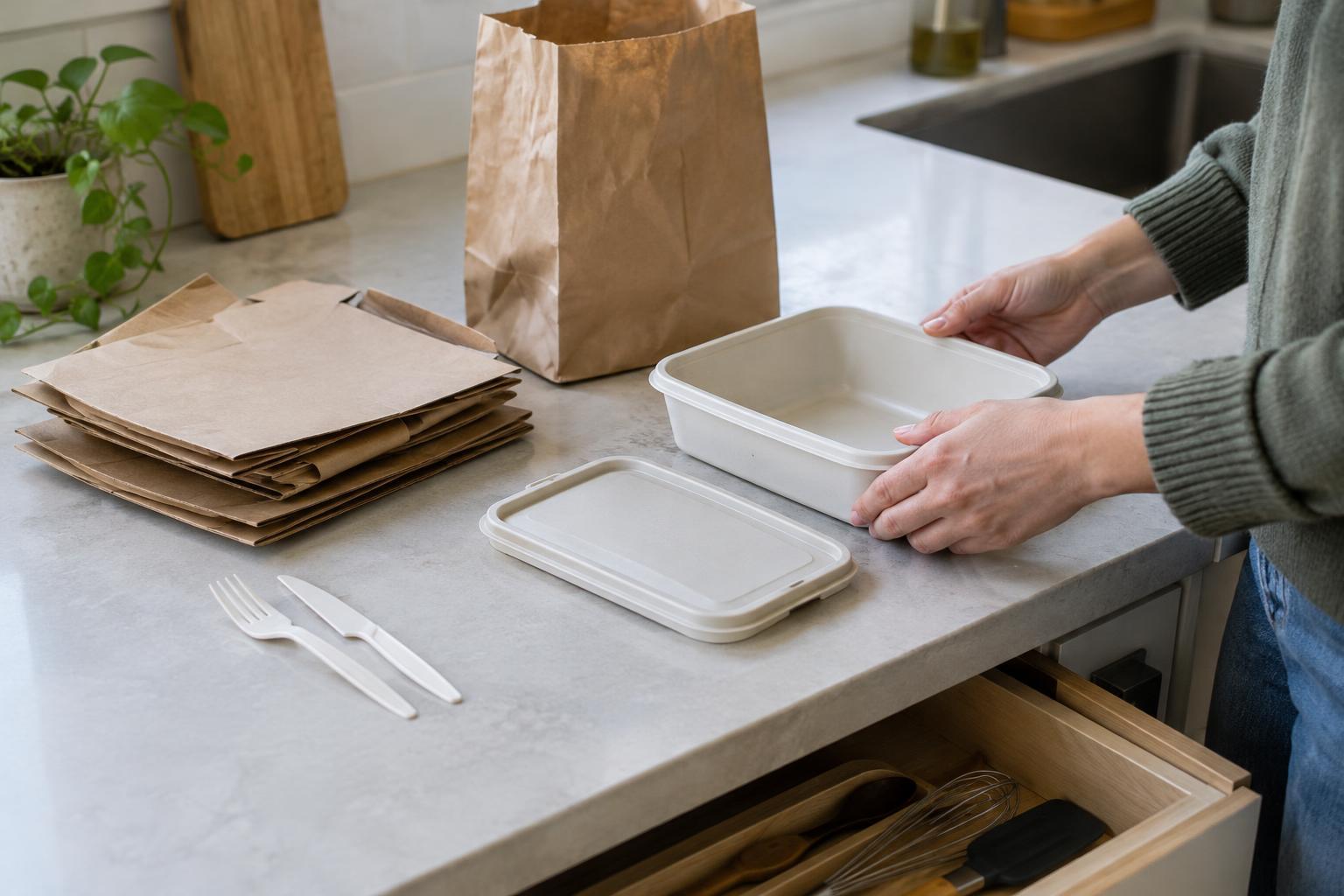
Unpack the order near the sink, trash and recycling containers rather than spreading it across the counter. Put food away first, then gather bags, lids, cups and wrappers in one spot. This makes it easier to see what arrived and prevents packaging from lingering after the meal. If a container holds leftovers well, use it for those leftovers before deciding whether it deserves longer-term storage.
For anything you might keep, ask a specific question: What will I use this for, and when? A sturdy paper bag may be useful for your next donation drop-off; ten similar bags may simply take up cabinet space. Set a modest limit, such as one small bag for spare bags or a single drawer section for usable containers. When that space is full, use what you have before saving more.
Sort by material and local rules
Takeout packaging is not one uniform waste stream. A clean cardboard sleeve, a greasy box, a plastic tub and a lined paper cup may need different handling. Recycling rules vary by location and collection service, so check your local guidance instead of relying on a symbol or assuming that an item’s material makes it acceptable. If a package has separable parts, such as a cardboard sleeve around a plastic container, sorting them separately may help where local rules allow it.
Empty containers and remove obvious food residue before recycling items your service accepts. There is no need to save packaging indefinitely while searching for a perfect disposal option: choose the appropriate bin based on the information you have. If your area offers food-scrap collection, follow its rules for scraps and any accepted paper products. Keeping the sorting routine simple makes it more likely that you will follow it after a busy evening.
Reuse selectively, not automatically
Reuse can be worthwhile when an item replaces something you would otherwise need. A clean, intact container might carry a non-food item or organize small supplies. But takeout containers vary in durability and intended use. Avoid reheating food in a container unless it is clearly suitable for that purpose, and discard one that is cracked, badly stained or difficult to clean. A growing stack of “maybe useful” packaging is not a practical reuse system.
The same test applies to condiment packets and disposable utensils. Keep only flavors you enjoy and expect to use soon, and store them where you can see them. If you regularly take lunch out, a small set of your own utensils may be more useful than collecting disposable sets. When an extra repeatedly goes unused, adjust your next order rather than building a bigger stash.
Make the routine easy to repeat
A low-waste approach should fit ordinary life, including evenings when cooking is not realistic. Try a two-minute reset after eating: refrigerate leftovers, sort accepted recyclables, put any genuinely useful items in their assigned place and dispose of the rest. If you share a home, agree on where saved containers belong and how many you will keep. Clear limits prevent one person’s useful spare from becoming everyone else’s clutter.
Notice patterns over several orders. If one meal reliably produces unused sauce packets, stop requesting sauce. If a particular container works well for leftovers, use it before saving another. The goal is not to make every delivery packaging-free. It is to order with intention, handle what arrives promptly and keep household space for things that serve a real purpose.